
Timeless Porcelain: Why the Refill Shell Just Became a Strategic Choice
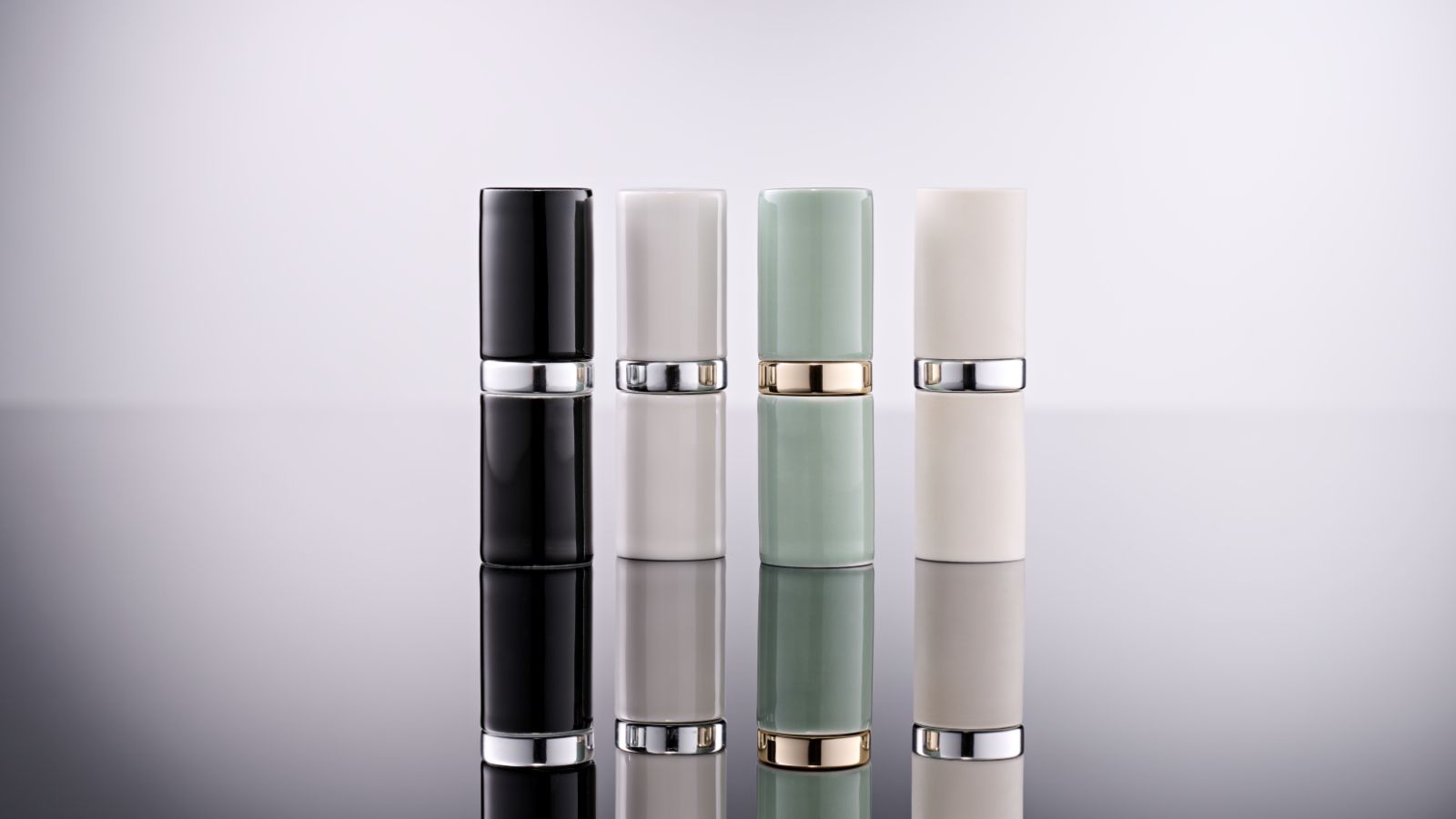
Refillable packaging used to be a sustainability story. Under the EU's new Packaging and Packaging Waste Regulation (PPWR), it becomes a compliance story too — which means the material choice for the shell, the part the consumer keeps, has to do more than look premium. It has to last.
For our latest refillable lipstick, we chose porcelain.
A material that earns its place on a vanity
The Corpack Refillable Porcelain Lipstick pairs a porcelain cap and base with a PP cup and an aluminum a-shell — Ø 23 mm, 75 mm tall, with a Ø 12.7 mm cup. Porcelain made in Germany.
The format is built around a simple idea: the shell stays, the cosmetic gets replaced. Porcelain makes that idea work in a way few other materials can. It feels substantial in the hand. It's cool to the touch. It doesn't scratch under daily handling, doesn't yellow with age, and doesn't pick up oils from skin or fragrance from a bag. A porcelain lipstick on a dressing table reads as an object, not a wrapper — and that perception is precisely what convinces a consumer to refill rather than replace.
Ceramic vs. porcelain — a quick distinction
The two terms get used interchangeably in marketing, but they aren't equivalent. Porcelain is a type of ceramic, not a synonym for it. The differences come down to the recipe and the kiln:
- Material. Porcelain is made primarily from kaolin (china clay), a finer and purer base than the mixed clays used in earthenware or stoneware.
- Firing temperature. Porcelain is fired at roughly 1,200–1,450 °C — considerably hotter than standard ceramics. This vitrifies the body: at the molecular level, it becomes glass-like.
- Porosity. Fired porcelain absorbs less than 0.5 % water. Most ceramics absorb several percent.
- Density and strength. Porcelain is harder, denser, and noticeably more chip-resistant than typical ceramics.
- Appearance. A characteristic translucency at thin sections, a fine grain, and a clean white that takes pigments and glazes evenly.
For packaging, the practical takeaway is that porcelain is the closest a "natural" material gets to behaving like premium tempered glass — without the cold, mass-produced feel that glass can carry.
Why shell quality matters more under the PPWR
Regulation (EU) 2025/40 — the Packaging and Packaging Waste Regulation — entered into force on 11 February 2025 and applies from 12 August 2026. It replaces the old Packaging and Packaging Waste Directive with rules that apply directly across all EU member states, ending the patchwork of national requirements.
Three PPWR pillars push brands toward refill systems:
- Recyclability by 2030. Almost all packaging placed on the EU market must be recyclable. Materials that meet that bar at scale — porcelain, aluminum, well-designed monomaterials — move to the front of the design conversation.
- Reuse and refill obligations. Member States must support refill systems, and reuse targets apply to selected categories. Brands are expected to design with refill in mind, not bolt it on at the end.
- Reduction of unnecessary packaging. A refill cartridge that slots into a kept shell uses a fraction of the material of a fresh single-use unit.
This shifts what a refill shell actually has to do. In a "nice to have" sustainability program, a refill shell only needs to look the part. In a regulated refill economy, it has to survive dozens of refill cycles — opening, closing, dropping, traveling, refilling — without losing its finish or its mechanics. A shell that cracks, fades, or feels flimsy after six months breaks the refill loop. The consumer reverts to single-use.
Porcelain solves that durability problem without trading off prestige. Aluminum — which we use here in the a-shell sleeve — solves it on the structural side. The combination produces a refill system that is genuinely built to last and is straightforward to communicate under PPWR's new harmonised labelling rules.
Where porcelain fits in our material portfolio
Porcelain joins our broader range of alternative materials — alongside BioD (our 100 % bio-based, paper-derived biodegradable compound) and Sughera (70 % recycled cork + synthetic rubber, with a biodegradable variant). The common thread: materials that let brands move past petroleum-based plastic without compromising on what packaging is supposed to do at the point of sale.
Thirty years of cosmetic packaging out of Munich has taught us one thing about refill systems: they only work if the shell is worth keeping.
Porcelain is.
Let's build something timeless.
Talk to our team about a porcelain refill concept for your brand — info@corpack.de | +49 89 8188 7508

